
COACHED RECORD ATTEMPT
Three Records. Two New World Record Holders.
The women’s Self-Caught Flight records on ice skates didn’t exist. So I invited two Calgary ultimate players with very different skating backgrounds to help establish them — and then we trained together to see what they could do.
RECORDS ATTEMPTED
Women’s Maximum Time Aloft, Throw, Run and Catch, and Self-Caught Flight on Ice Skates
THE OPPORTUNITY
The records didn’t exist yet. We had the chance to create them.
I had already been competing in Self-Caught Flight on ice skates and was preparing to return to Edmonton’s Silver Skate Festival in 2017 to attempt my own records. This time, though, I wanted the event to include women pursuing the same disciplines.
There were no women’s records yet, so I recruited two ultimate players from Calgary who brought very different skating backgrounds to the challenge. Jill Duffy skated in hockey skates, while Jennie Orsten was a figure skater. Both knew how to throw a frisbee, but neither had trained specifically for Self-Caught Flight on ice.
That gave us something interesting to work with. The fundamentals of the events were the same, but the way Jill and Jennie moved on the ice, accelerated, threw and positioned themselves for the catch wasn’t identical. We spent the weeks leading up to Silver Skate working closely together, learning the techniques and figuring out what gave each of them the best chance of success.
This wasn’t simply a matter of showing them a record and wishing them luck. We were preparing for it together.
THE ATTEMPT
Weeks of training came down to one day on the ice.
As the event got closer, our training became increasingly specific. We worked through throwing technique, skating speed, positioning and the timing required to catch your own throw while moving on skates. Even the day before the attempts, we were still testing the ice at Hawrelak Park, learning where to set up and making adjustments based on what we were seeing.
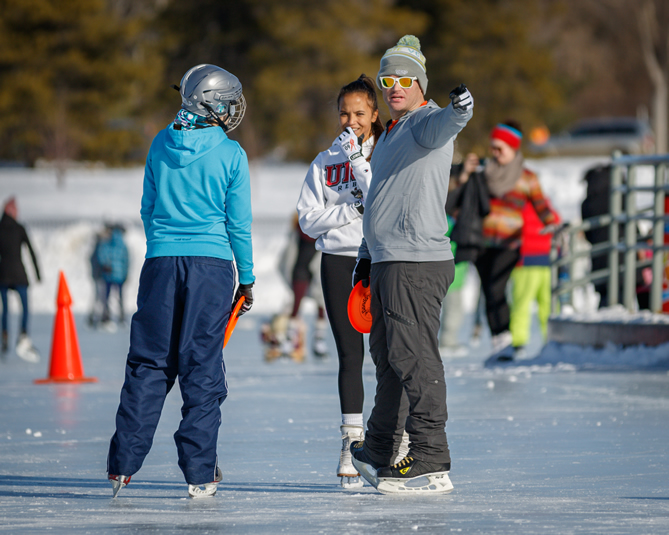
On February 11, 2017, Jennie, Jill and I took to the ice at the Silver Skate Festival in Edmonton to make the official attempts. Discovery Channel was also documenting the event, adding another layer to a day we had already spent weeks preparing for.
By the end of the event, all three women’s Self-Caught Flight on Ice Skates records had been established.
Jill set the Women’s Throw, Run and Catch record at 31.3 metres — 102 feet — and the Women’s Self-Caught Flight record with a score of 62.73.
Jennie established the Women’s Maximum Time Aloft record with a throw and catch of 6.22 seconds.
I also broke my own Men’s Throw, Run and Catch record that day with an 87.8-metre throw and catch, bringing the total to four new WFDF world records at the event.
For Jennie and Jill, though, there had been no previous women’s performances to chase. Their preparation and their results became the first benchmarks.
WATCH THE STORY
Jennie & Jill at the Silver Skate Festival
WHAT IT CREATED
Coaching meant helping each athlete find her own path to the same target.
Jennie and Jill’s experience was different from simply introducing someone to a record opportunity and letting them take it from there. I was part of the preparation. We trained together, worked through technique and kept looking for adjustments that could help each of them perform better.
What made that especially interesting was how different they were as athletes. Jill brought a hockey-skating background. Jennie brought figure skating. They were attempting the same disciplines, but there wasn’t one perfect way to prepare both of them.
That forced me to think beyond simply teaching the technique that worked for me. The goal was to understand what each athlete already brought to the challenge and then help her build from there.
There was another reason I wanted them involved. At the time, the women’s categories didn’t have records at all. Creating those benchmarks meant that the next women who came along would have something tangible to pursue. In my 2017 recap, I wrote that having role models for both boys and girls was an important reason for supporting the women’s records in the first place.
That’s still relevant to how I think about Record Experiences today. Sometimes creating the opportunity means identifying the target. Sometimes it means opening a category that hasn’t existed before. And sometimes it means staying involved through the preparation so someone else has the best possible chance to succeed.
We weren’t only chasing existing records. Jennie and Jill were creating the benchmarks for whoever came next.
YOUR NEXT RECORD
What could your next record be?
Whether it’s a world record, an organizational record or a personal best, the first step is identifying a target worth changing for.